Improving Your Process, Enhancing Your Products, Increasing Your Profits

Propagation

MDA Seeks Input Before Next Legislative Session

Two virtual public input sessions offer chance to share ideas

The Minnesota Department of Agriculture (MDA) is gathering ideas as it considers the state’s next biennial budget and is seeking public input. Farmers, food businesses, and others impacted by food and agriculture systems are all invited to share policy, funding, and program suggestions.

The MDA is hosting two virtual public input sessions where people can share their ideas directly, in addition to an online form for written submissions open through September 15, 2022.

The two sessions will take place on Zoom. Participation is free, but registration is required. The sessions are scheduled for:

Background: The Minnesota Legislature appropriates funds for the MDA and related agricultural activities through a two-year budget bill that is part of the state’s overall government funding.

State budgets are set in legislative sessions that take place in odd-numbered years and are sometimes revised during sessions in even-numbered years. The next legislative session begins on January 3, 2023, and will determine the next two-year state budget.

Vist the MDA website, www.mda.state.mn.us, for information about the department’s mission, leadership, and responsibilities.


USDA Launches New Organic Transition Initiative

WASHINGTON, Aug. 22, 2022 — Agriculture Secretary Tom Vilsack announced details of the U.S. Department of Agriculture’s (USDA) $300 million investment, including with American Rescue Plan funds, in a new Organic Transition Initiative that is intended to help build new and better markets and streams of income for farmers and producers.

According to the USDA National Agricultural Statistics Service, the number of non-certified organic farms actively transitioning to organic production dropped by nearly 71 percent since 2008. Through the comprehensive support provided by this initiative, USDA hopes to reverse this trend, opening opportunities for new and beginning farmers and expanding direct consumer access to organic foods through increased production.

The initiative will deliver wrap-around technical assistance, including farmer-to-farmer mentoring; provide direct support through conservation financial assistance and additional crop insurance assistance, and support market development projects in targeted markets.

“Farmers face challenging technical, cultural, and market shifts while transitioning to organic production, and even during the first years after successful organic certification,” said Vilsack. “Through this multi-phased, multi-agency initiative, we are expanding USDA’s support of organic farmers to help them with every step of their transition as they work to become certified and secure markets for their products.”

USDA’s Agricultural Marketing Service (AMS), Risk Management Agency (RMA) and Natural Resources Conservation Service (NRCS) are the primary agencies supporting the Initiative, which will focus on three areas.

Transition to Organic Partnership Program

Through this initiative, USDA aims to ensure that farmers transitioning to organic have the support they need to navigate that transition, including a full supply chain to U.S. consumers who demand organic choices in their supermarkets daily. AMS will build partnership networks in six regions across the United States with trusted local organizations serving direct farmer training, education, and outreach activities. The organizations will connect transitioning farmers with mentors, building paid mentoring networks to share practical insights and advice. Each regional team will also provide community building, including train-the-mentor support; as well as technical assistance, workshops, and field days covering topics including organic production practices, certification, conservation planning, business development (including navigating the supply chain), regulations, and marketing to help transitioning and recently transitioned producers overcome technical, cultural, and financial shifts during and immediately following certification. USDA will provide up to $100 million for this program.

Direct Farmer Assistance

NRCS will develop a new Organic Management conservation practice standard and offer financial and technical assistance to producers who implement the practice. Payments will be modeled on those already available to producers meeting the existing nutrient and pest management conservation practice standards. USDA will provide $75 million for this effort. This will include an increase in organic expertise throughout its regions, creating organic experts at each of its regional technology support centers. These experts will train staff who provide direct services to USDA customers. These services include hosting hands-on organic training for state and field NRCS staff and fielding organic-related staff questions.

USDA will provide $25 million to RMA for the new Transitional and Organic Grower Assistance Program (TOGA) which will support transitioning and certain certified organic producers’ participation in crop insurance, including coverage of a portion of their insurance premium.

Organic Pinpointed Market Development Support

Stakeholders have shared that specific organic markets have market development risks due to inadequate organic processing capacity and infrastructure, a lack of certainty about market access, and insufficient supply of certain organic ingredients. This AMS initiative will focus on key organic markets where the need for domestic supply is high, or where additional processing and distribution capacity is needed for more robust organic supply chains. Examples of markets seeking support include organic grain and feed; legumes and other edible rotational crops; and livestock and dairy. USDA will invest up to $100 million to help improve organic supply chains in pinpointed markets. The Department will seek stakeholder input on these pinpointed initiatives beginning in September, resulting in an announcement of specific policy initiatives later this year.

For additional information about MCIA’s Organic Services, please visit https://www.mncia.org/services-programs/organic-services.


Seed Lab Reminders

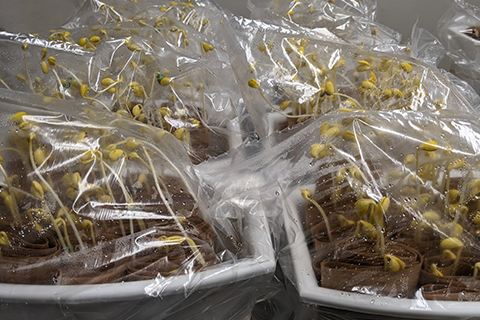
Photo © Minnesota Crop Improvement Association.

Friendly reminders to MCIA Seed Laboratory clients:

Be sure to include a Sampling Report with every sample submitted for testing. Whether it be for a retest or a germ update, a Sampling Report is necessary for recording date received, assigning a lab number, tests requested, as well as any other pertinent information regarding your seed lot.

New crop small grains and turf grasses may require extra germination time due to pre-chill requirements. Be sure to include the year of production on the Sampling Report.

Loose smut tests can be conducted on each barley field at the time of harvest, eliminating the need for a smut test on every lot. Loose smut results must be included on the bulk sales certificate or seed tag.


Labeling Certified Forage and Mulch

Image by manfredrichter from Pixabay.

Reminder to members enrolled in MCIA’s Noxious Weed Seed–free Forage and Mulch Program:

Bales are not certified until a certification label is securely attached to each bale prior to delivery to the buyer. Misuse of certification tags may result in loss of certification privileges.

To request certification tags, complete the tag request located at the bottom of your Inspection Certificate and return it to the MCIA Office.


Seed Grower Inspection Reminders

Image by mbrady321 from Pixabay.

Soybeans: The season for soybean field inspection will be here soon. If you have not yet submitted your field inspection appli­cation to MCIA, please get it in as soon as possible. This will allow our field inspectors to plan for an efficient and timely inspection season.

Small Grains: You can still have your small grain field inspected! To add a field contact your MCIA field supervisor.


Job Opportunity for Seed Lab Technician

Minnesota Crop Improvement Association is seeking qualified candidates for the position of Seed Lab Technician.

This full-time position offers a competitive salary and full benefits. MCIA’s Seed Laboratory operates out of MCIA’s main office on the St. Paul campus of the University of Minnesota Twin Cities.

For more information, read the full position announcement on our job openings page. Read more about the MCIA Seed Laboratory here.


2022 Winter Grains Directory Published

MCIA has published the 2022 edition of our annual Winter Grains Directory. Growers can use the Winter Grains Directory to identify sources of certified and registered rye, triticale, winter barley, and winter wheat seed. The Winter Grains Directory includes crop variety descriptions as well as producer location and contact information.

Additionally, the Winter Grains Directory includes information on the availability of barley, rye, and winter wheat foundation seed from Minnesota and our neighboring states.

To view the digital edition of the Winter Grains Directory, click here.


MDA Offers Waste Pesticide Collections in NW Minnesota

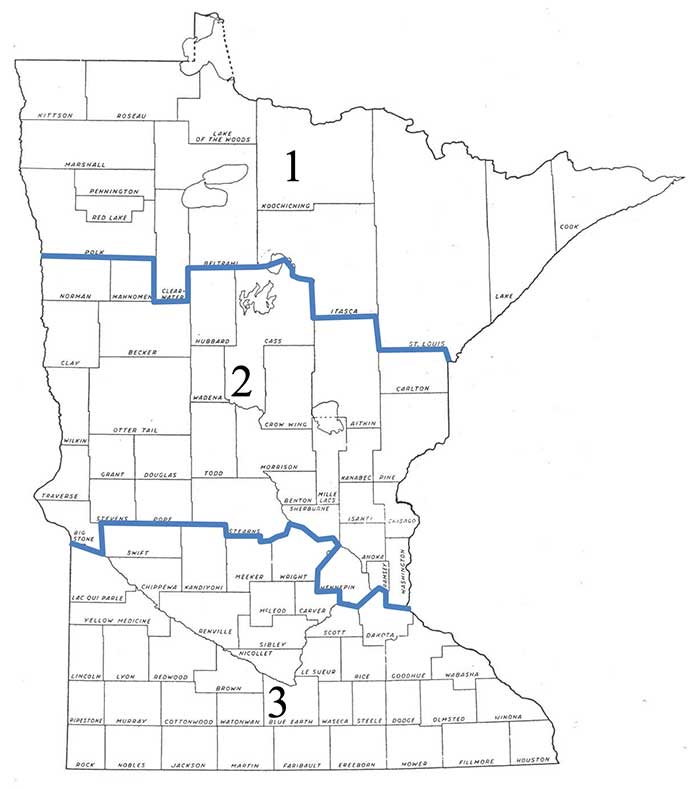
The Minnesota Department of Agriculture (MDA) is hosting a series of free waste pesticide collections available to residents in or near eleven northwestern Minnesota counties. Residents from Beltrami, Cass, Clay, Clearwater, Lake of the Woods, Kittson, Marshall, Pennington, Polk, Red Lake, and Roseau counties and the surrounding areas may attend any of the five collection sites on August 9-11.

The program accepts unwanted, unusable agricultural and consumer-type pesticides including insecticides, fungicides, herbicides, and rodenticides used in Minnesota. However, crop oils, adjuvants, pesticide rinsate, fertilizer, treated seed, contaminated soil, and empty pesticide containers will not be accepted.

The collections are open to farmers, homeowners, commercial pesticide applicators, golf courses, lawn care companies, structural pest control operators, and other pesticide users. No pre-registration for the MDA events is required, and collection sites will accept up to 300 pounds of eligible product at no cost. However, the MDA requests pesticide users call 612-214-6843 to provide advance notification if they wish to drop off more than 300 pounds of product.

The 2022 MDA collections will be held at the following locations and times:

  • August 9: CHS Ag Services, 1009 South Atlantic Ave., Hallock,  2–4 p.m.
  • August 10: CHS Ag Services, 420 South Main, Warren,  9–11 a.m.
  • August 10: CHS Ag Services, 806 Elevator Road, Oklee,  2–4 p.m.
  • August 11: CHS Ag Services, 3035 Highway 75 South, Crookston,  9–11 a.m.
  • August 11: West Central Ag Services, 334 1st Street SE, Ulen,  2–4 p.m.

The MDA has collected approximately 10 million pounds of pesticides around the state since the Waste Pesticide Collection Program started in 1990.


Advertise in the 2023 MCIA Directory

Advertising in MCIA’s Directory is an affordable and effective way for members to promote their businesses.

Every year, we distribute approximately 1,600 printed copies of the Directory to farmers, seed producers, conditioners, wholesalers, retailers, organic producers and processors, and many others. A digital version of the Directory is also available on the publications page of the MCIA website.

We have begun preparing the 2023 edition and are scheduled to go to press in October.

MCIA members who are enrolled in the Approved Facilities Program and MCIA-certified organic handlers can expect to receive an informational mailing soon regarding Directory advertising. To assure that your ad appears in the 2023 Directory, please place your reservation by September 2.

Ads from non-member businesses and organizations are also welcome.

To view 2023 Directory ad rates and specifications, click here. To place an ad reservation or to ask for more information, contact Communications Specialist Alan Makinen at alan.makinen@mncia.org.