Improving Your Process, Enhancing Your Products, Increasing Your Profits

Propagation

MCIA Announces Duane Dahlman as Executive Director


On behalf of the Minnesota Crop Improvement Association (MCIA) Board of Directors, Chair Brent Benike, is pleased to announce the selection of Duane Dahlman as the new Executive Director of the association effective as of January 1st, 2026.  

Duane has a lifetime of experience working in both the seed and food industries. He was one of 3 owners of Dahlman Farms/Dahlco Seeds of Cokato, MN and held that position for over 40 years. The business was sold to Western Integrated Seed (WIS), and Duane worked with WIS for a number of years. Most recently in his career, he was working as an Ag Production Supervisor with Seneca Foods in Glencoe, MN.   

Duane holds a B.S. in Agronomy from the University of Minnesota. While at the University, he was a member of the National Champion, University of Minnesota crops judging team. He has served various agricultural organizations, including MCIA, the Wright County Soil and Water Conservation District, and U of M Extension in Wright County. He has also demonstrated a commitment to area youth by dedicating time to 4H, FFA, and athletic organizations. In addition, he is involved in community events and church-based activities. Duane has also served MCIA as member of the board of directors for 12 years and was chair for 2 of those years. For the past several years, he has been in the category C, secretary position on MCIA’s board. 

The organization is excited to have Duane’s leadership and industry knowledge applied to MCIA’s mission and focus on our members and clients. 


2026 MCIA Directory Published

MCIA has published the 2026 edition of our annual Directory. The Directory contains listings of agronomic crop, native, and organic seed; certified forage and mulch; quality assured seed and sod; approved seed conditioning and bulk seed handling facilities; and producer contacts. As well, the Directory provides information regarding MCIA’s many services and programs.

To view the digital edition of MCIA’s 2026 Directory, click here.


2025 Winter Grains Directory Published

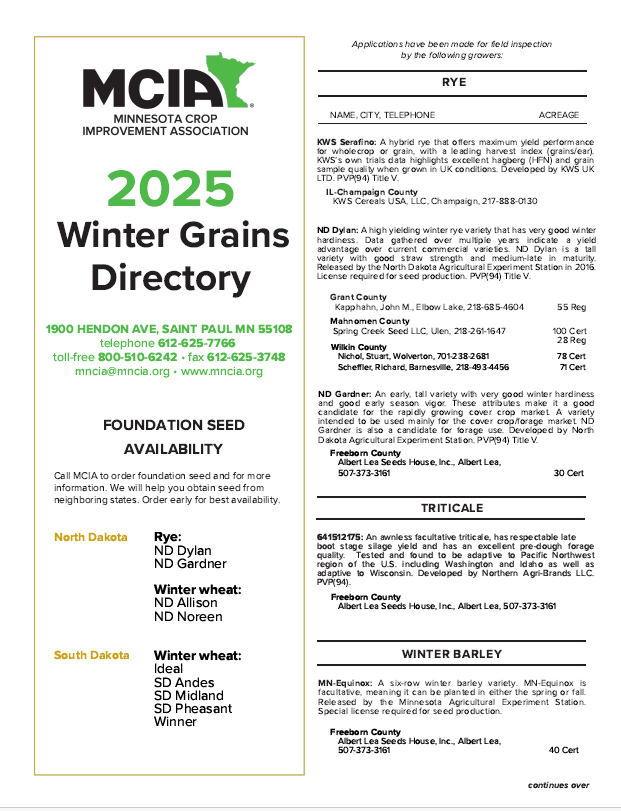
MCIA has published the 2025 edition of our annual Winter Grains Directory. Growers can use the Winter

Grains Directory to identify sources of certified and registered rye, triticale, winter barley, and winter wheat seed. The Winter Grains Directory includes crop variety descriptions as well as producer location and contact information.

Additionally, the Winter Grains Directory includes information on the availability of rye and winter wheat Foundation seed from our neighboring states.

View the digital edition of the Winter Grains Directory here: https://docs.mncia.org/public/website/WinterGrainsD25.pdf.


Seed Testing Tips

Wheat seeds. Photo by David Hansen. © Regents of the University of Minnesota.

If you haven’t submitted your seed samples to the MCIA Seed Laboratory for testing, do so now!

Verifying that seed standards are met is one of the last steps in the certification process.

Germination tests take at least seven days, and HPLC for wheat and oat variety ID testing can sometimes take longer. Rush service can be requested.

If Fusarium (scab) is of concern, adding a sand test may be beneficial.

Be sure the information on your Sampling Report is complete and accurate.


Plan for Field Inspection Applications

Field of Shelly wheat. Farm of Harmen Tande in Clay County, Minnesota. Photo by David Hansen. © Regents of the University of Minnesota.

Each year, there are some growers from whom we do not initially receive all the information necessary to complete field inspection. In those cases, we need to do follow-up work. So, as the planting season begins, we remind field inspection clients to keep accurate records and:

  • Pay past due accounts.
  • Save your proof of seed source (tags or bulk certificates).
  • Maintain proper isolation and field history between varieties and other crops.
  • New varieties—we need a variety description to complete inspections and pass fields, appropriate forms can be found online or by contacting the office.

Questions? Contact your MCIA field supervisor or the MCIA Office staff for answers. Our contact information is listed on the Staff page of the MCIA website: https://www.mncia.org/staff/.


Upcoming Field Inspection Application Deadlines

Image by Hojun Kang from Pixabay.

Please note these dates to avoid late fees:

  • June 7: Small grains, corn, and sunflowers
  • June 7 or 3 weeks after planting (whichever is first): Soybean post-spray inspections
  • June 7: Soybean bloom inspections
  • July 15: Soybeans (pre-harvest inspection only)
  • Year of seeding: Perennials
  • 4 weeks prior to cutting: Noxious weed seed–free forage and mulch
  • Within 18 months of the year established for native grasses and forbs

Information packets for Field Inspection Applications will be mailed in May. Application documents may also be downloaded from the Client Resources page of the MCIA website: https://www.mncia.org/resources.

If you have any questions, please contact your field supervisor. (Field supervisor contact information is listed on the Staff page of the MCIA website: https://www.mncia.org/staff/.


Minnesota Hemp Growers and Processors Must Apply by April 30 for 2025 Season

Hemp field. Photo by NickyPe from Pixabay.

Licenses are for industrial hemp only

Those wanting to grow and process hemp in Minnesota in 2025 must apply for a license with the Minnesota Department of Agriculture (MDA) by April 30. Each license is valid only through December 31 of the year it is issued. Licensees must reapply annually to remain in the program. A license from the MDA is required for individuals and businesses.

As of April 2, 2025, about 50 people have applied for a 2025 MDA license. In 2024, there were 183 applicants.

These licenses are for growing and processing industrial hemp only. The hemp grower or processor application is not for the growth or sale of adult-use or medical cannabis. The application is also not intended for the sale of hemp-derived cannabinoid products. Adult-use and medical cannabis information can be found on the Office of Cannabis Management website: https://www.health.state.mn.us/people/cannabis/index.html.

The industrial hemp application can be found on the MDA website: https://mn.gov/ocm/. Along with the online form, first-time applicants and authorized representatives need to submit fingerprints and pass a criminal background check.

Growers and processors need to be aware of the following for 2025:

  • All authorized representatives designated by the applicant must pass a criminal history background check prior to the issuance of a license.
  • Every lot of hemp grown requires pre-harvest THC regulatory testing. Each official regulatory sample collected by the MDA will cost $100.
  • The MDA licenses processors that handle raw hemp and initially process it by extraction, decortication, devitalization, crushing, or packaging, and the department will continue random inspections of processor locations.
  • License fees will remain the same for new and returning applicants plus a 5% surcharge to support the modernization of the MDA’s technology systems. The minimum cost of a grower license is $400. A processing license is a minimum of $500.

Questions about the MDA’s Industrial Hemp Program should be sent to hemp.mda@state.mn.us or 651-201-6600.

Background

Industrial hemp, hemp, cannabis, adult-use cannabis and marijuana are all types of the same plant, Cannabis sativa. Industrial hemp differs by the concentration level of the psychoactive compound tetrahydrocannabinol (THC) within the plant containing 0.3% total THC or less, and levels above that are considered adult-use cannabis or marijuana. MDA does not license or oversee the manufacture or sale of hemp-derived cannabinoid extracts and products. They are regulated by the Office of Cannabis Management.


Ready for Spring?

Wood anemones. Photo by ViJakob from Pixabay.

Time to Test Your Seed

The Seed Laboratory is busy, and it will take at least 7 days to get test results before issuing final reports, bulk certificates, and tags. So, have your seed tested now. You don’t want to be waiting for a test when it is planting time.

A few other items to keep in mind:

  • Update your germination. If you have carryover seed, be sure the label has a germination test date that complies with the seed law.
  • Submit a Sampling Report with all samples, complete with field numbers, lot size, number of bags or totes, and tests requested.
  • Be sure you received a passed seed certification report before any tags or bulk certificates are issued.
  • Always tag or issue bulk certificates for the seed you distribute.
  • Resolve any issues about eligibility of seed source before planting.
  • Retain your tags or bulk certificate as proof of seed source for your field inspection application.

Repackaging Certified Seed Procedures

When repackaging certified seed and retesting is required, follow the procedures described in the Seed Certification Handbook, pages 18 through 19.

When repackaging certified seed and retesting is not required, a Lot Number Change Request Form must be submitted in order for certification to be valid on the repackaged lot.

For seed certified by another state, be sure to include the original certification label and analysis results showing a MN Noxious Weed Exam or All-States Noxious Weed Exam was completed. A MN Noxious Weed Exam is required on Minnesota certified seed.

The MCIA staff is available to answer any questions you have. Please contact the MCIA Office or your field supervisor.

Submitting Samples to the Seed Lab

To ensure that your samples arrive in good condition use a good quality, leak-proof bag and quality packaging. For fragile seeds (like soybeans) use a sturdy box and use packing material to keep them from getting bounced around during shipping. You may want to write ‘Fragile’ on the package.


Lab Report

Hoffman SG30SS germinators. Photo by Chase Mowry. © Minnesota Crop Improvement Association.

By Chase Mowry, Seed Laboratory Manager

The Seed Laboratory has recently received two new Hoffman SG30SS germinators. Last spring, one of two Norlake germinators that MCIA purchased in 1988 went down. Replacement parts are no longer available for the unit. At that time, a Hoffman SG50SS double-door unit was purchased as a replacement; it is currently being used as a pre-chill chamber for small grains.

The two new single-door units recently received were proactively purchased as replacements for the remaining Norlake unit. The new units are programmable with day/night temperature control and light settings—both functions are an upgrade from the predecessor units.

As outlined in the AOSA Rules for Testing Seeds, temperatures for germination tests must be maintained within 1 °C of prescribed testing parameters. In addition, as part of accreditation, germinator temperatures are monitored with the use of data loggers, providing the ability to retrieve temperature information for any given time period, if needed.

The purchase of the two single-door units, as opposed to one larger, double-door unit, provides an additional advantage: greater flexibility regarding testing options.

Regarding germination testing, we are continuing to pre-chill wheat due to Fusarium infection still being present in some samples. Although pre-chilling adds additional time to testing, it should help yield better results.


Field Notes

Photo by tlford from Pixabay.

By Field Services Staff

The seasonal Field Notes column often follows a similar theme from one year to the next, including this one.

Germination results for some seed lots are lower than expected. There have been instances in the past few months where the germination is lower after conditioning. We encourage all our members to check germination on all seed lots as soon as possible. The presence of Fusarium and pre-harvest sprouting in small grains grown in 2024 is significantly higher than the past few years.

Other spring planting reminders:

  • Make sure seed sources have met all requirements needed and save proof of seed source
  • Verify your intended seed fields meet crop history requirements
  • Apply for field inspection after planting
  • Contact MCIA with any questions or field inspection needs