Hello everyone. In my last Chairman’s View, I mistakenly stated that it would be my last column for you. I was wrong in that statement, and I ask you to please bear with me as I try not to bore you to tears one last time.
During the Annual Meeting in St. Cloud this past January I gave my Chairman’s Report on the status of MCIA. I spoke for the Board of Directors, assuring the members that MCIA is forward thinking and is in a good financial position for the future of this organization. The future of MCIA is positive.
–
Have you ever taken the time to look back on your life at all the jobs you had and picked out your favorite? Your reflection may reveal fun stories from the past to share with and entertain family or friends. Don’t get me wrong, I absolutely love farming and conditioning seed and can’t imagine doing anything else now. But here are my top three picks before farming.
First: The summer of my fifth grade I rode my bicycle into town, and I worked daily at my dad’s friend’s gas station. I pumped gas and washed windows and even put cars up on the hoist, changed the oil and greased the driveline. Many times, I was left to attend the place by myself for a few hours. Fifty-some years later, I still meet former customers who remember that little kid pumping gas.
Second: In college, I was the beer delivery guy at the local off-sale. I was paid an hourly wage, per delivery fee, and great tips. Everyone loved the beer delivery guy.
Third, was being the chairman of the board at MCIA. This job came with the satisfaction of helping guide a very old institution through the current times. During this period, I met and worked with some super intelligent and talented individuals.
We may all be a little old for my first two picks, but if you ever get the chance to work on a board of directors, do so, as it is very rewarding, and you meet some great professionals.
Your new chairman of the board, Brent Benike, is a fantastic individual. Brent is well educated, hardworking, very knowledgeable, and well grounded. Brent will be an excellent leader for MCIA. When you get the opportunity to visit with him, you will understand what I am saying.
2025 will be a challenging year for all of us as margins are slim and expenses seem to increase steadily, but take joy in what you do and someday (maybe today) you will call your current job, your favorite job.
At every annual meeting of the Minnesota Crop Improvement Association, the association’s president reports on MCIA’s activities over the past year and provides an assessment of the state of the organization. Following are highlights from Dr. Fawad Shah’s presentation to MCIA membership on January 29, 2025.
The President introduced MCIA’s staff members, presented a history of MCIA, and explained the roles of MCIA committees. Next, he reported that fiscal year 2023–2024 was another successful year for MCIA. Total revenues were $3,625,981 while total expenses were $3,443,619. As of January 15, 2025, the general investment account balance is $5,370,733 and the building reserve fund account balance is $828,740. Organic Services led all departments in revenue generated followed by Field Services, Certification Services, Foundation Seed Services, and the Seed Laboratory. Major expenses for all departments include salary, benefits, and payroll taxes.
The President then reported staffing, recruitments, and transitions within the organization. Organic Services hired Frances Schuster, Maddie Barkholtz, Karen Lehto, and Kristen Adams. Seed Laboratory Services hired Sean Manzano-Rabbit and Amy Olson. MCIA will prepare for the upcoming retirements of Alan Makinen, Communications Specialist, and Michelle Menken, Organic Services Manager on Special Assignment.
MCIA’s Field Services inspected roughly 180,000 acres in 2024. The department inspects nearly 180 facilities each year under the Approved Facility Program. Field Services is working with the Minnesota Compost Council to develop a third-party inspection audit-based program.
The MCIA Seed Laboratory tested 3,222 samples in the past year. The top five crops being tested are perennial ryegrass, soybeans, corn, wheat, and oats. MCIA’s Seed Laboratory is now a Canadian Food Inspection Agency foreign recognized seed testing lab. Training of new staff continues.
Foundation seed sales were down 26 percent compared to last year. This is primarily due to the University of Minnesota having released no new wheat variety. Soybean variety line increases included a black seeded soybean, a food grade clear hilum soybean, and high oleic oil type soybean.
In their audit of MCIA’s Organic Services, the USDA National Organic Program issued 17 non-compliances. Many of the non-compliances were related to Strengthening Organic Enforcement (SOE) regulatory requirements. MCIA completed its responses to the non-compliances within the requested time. MCIA has changed the department’s management structure to include five team leads. The Board of Directors approved the purchase of a FileMaker database for the sustainability, functioning, and future of the department. Organic Services received recognition from USDA NOP for hosting a delegation from Taiwan and for performing a witness inspection.
Next, the President reviewed the ways that the association informs our members: through its publications, the Directory, the Minnesota Seed Grower, Samplings, and the Minnesota Certified Seed Guide, and through its website, which includes a blog, press releases, and industry news articles.
In conclusion, the President described ways that the association has engaged in capacity building. He accepted an invitation to give a talk and conduct workshops on seed germination, viability, and seed sampling at the Third International Pakistan Seed Congress. He also traveled to Taiwan along with Mr. Kabus van Huyssteen from the South African National Seed Organization to assist Taiwan in their effort to apply for and join the OECD Seed Schemes.
On January 29, 2025, members of the Minnesota Crop Improvement Association joined the organization’s staff and board members for the Association’s 122nd Annual Meeting.
Courtney Cheever, Natural Resources Conservation Service (left); Alex Udermann, Meadowbrook Farm (right).
Cover Crops—Fundamentals and More
The program began with an informative panel discussion on the topic Cover Crops—Fundamentals and More. Four panelists fielded questions from the moderator, MCIA President/CEO Fawad Shah, and from attendees. Alex Udermann, of Meadowbrook Farm in Sartell, described a cautious, patient, and practical approach toward adoption of regenerative farming practices. It took four to five years to see convincing improvement in soil health on his farm, but, he said, “We didn’t spend any money those five years unless we saw the benefits.” Alex endorses the use of cover crops as part of a broader strategy, including no-till, plant diversity, integrated livestock, manure, and compost. “You can’t just do a cover crops and get the success we have,” he said. “We have to do all five soil health principles to get the success we want to see. So we can’t just pick one and expect great results.”
Courtney Cheever, of the Natural Resources Conservation Service (NRCS) in Minnesota, discussed how cover crops can help manage erosion by protecting the soil. Forming a buffer, cover crops allow rainwater to infiltrate soil that is more permeable rather than running off and degrading exposed soil surfaces. Also, “they help suppress the weeds because when you harvest that crop and then you plant a cover crop in there—the intent is—there’s not a whole lot of room for competition, so the weeds won’t grow.” Another benefit of cover crops, as a component of no-till farming, is a reduction in pests through improved soil health. To growers who are interested in financial incentives, NRCS offers two programs, the Conservation Stewardship Program (CSP) and the Environmental Quality Incentive Program (EQIP). “Both of those can provide financial assistance to plant cover crops,” Courtney said.
Matthew Kelly, Agassiz Seed & Supply (left); Michael Merriman, Minnesota Department of Agriculture (right).
Michael Merriman, Seed and Biotechnology Supervisor with the Minnesota Department of Agriculture, stated the purpose of governmental regulation of cover crops: to protect the consumer and to maintain a fair marketplace. He cautioned growers to understand the difference between seed and grain, “Anything that’s been labeled as feed, as grain, is not seed. It hasn’t been tested. You don’t know what’s in it. You don’t know if there’s noxious weeds. You don’t know what variety it is.” “There’s a lot of unknowns there. So, the consumer is not being protected.” Fielding a question about who is culpable when dishonest transactions occur, he answered, “It’s definitely an illegal practice to be selling grain if you know that the customers are going to be buying it and planting it.”
Matthew Kelley, Product Manager/Buyer for Forages and Covers at Agassiz Seed & Supply, spoke about how he works with customers to match the goal they are trying to achieve—erosion management, nutrient cycling, forage—to the most appropriate cover crop for that purpose. He and Courtney Cheever both confirmed that the use of cover crops is increasing. “The most common cover crop right now in Minnesota is winter rye grain,” Matt said. “It’s an over-wintering annual and, and it is planted extensively across Minnesota.”
Professor Mitch Hunter, UMN, Forever Green Initiative (left); Shane Frederick, Specialty Soya and Grains Alliance, (right).
Creating Opportunities for Farmers and Businesses
Then, Mitch Hunter, PhD, Co-Director of the Forever Green Initiative at the University of Minnesota, addressed the topic Creating Opportunities for Farmers and Businesses. Professor Hunter provided an overview of the Forever Green Initiative’s work. It is developing “continuous living cover” solutions to the pervasive problems of the soil and water degradation that result from common agricultural practices that rely on annual crops and leave soil uncovered for several months after harvest.
Professor Hunter emphasized that the Forever Green Initiative takes a comprehensive approach to its work. The University of Minnesota’s research and development work is crucial, but it is only one part. They see their work as building value chains. The university has a commercialization team that works with industry, and Forever Greens works “with a broad group of people across the private sector, the public sector, NGOs, etcetera, to change our policy landscape, the economic and cultural conditions that allow us to make a big change and bring a new crop into the marketplace.”
In his talk, Professor Hunter focused on the intermediate wheatgrass Kernza and the oil seeds winter camelina and pennycress, three of the fifteen crops that Forever Green is developing. Each holds out economic promise for farmers and ag-related businesses.
Kernza is the first perennial grain in the marketplace. It is performing well among organic consumers. “On the other hand, the conventional market is struggling,” said Hunter, due to consumer price-sensitivity. Kernza has a comparatively higher price than other grains on the market. What are Kernza’s selling points? For consumers, it tastes good. For soil health, it has a “deep, dense, perennial root system.” Compared to corn, “Kernza takes less fertilizer, but it’s also incredibly efficient at ensuring that that fertilizer doesn’t move through the rooting zone and into the groundwater or other waterways,” asserted Hunter. The result is a “90 plus percent reduction in potential nitrate leaching.” The story of Kernza will continue as the plant is further developed by the University and as processors innovate.
Professor Hunter turned next to the winter oil seeds: winter camelina and pennycress. Both are extremely winter hardy. They keep the soil covered. Even when fertilized, they “keep the soil water nitrate level below the drinking water standard.” They have high yield potential and high oil content. There are many potential markets for these crops, but currently the greatest interest is in low carbon fuels, especially for use in the aviation industry. One big success: “We did have a flight to come out of MSP airport, fueled by oil . . . fuel that was made from the oil grown in this pilot” program, explained Hunter. “But it really was just a proof of concept, and there’s a lot more work that needs” to be done to scale up. Other markets include heart-healthy food oils and high-protein livestock feed.
“To really scale, we need to be growing these with soybeans,” said Hunter. However, farmers would need to adapt to a new relay cropping system to grow winter camelina in concert with soybeans. An even greater potential could be reached if winter oil seeds could be grown following grain corn—eight million acres could be planted in the state. Other challenges remain. The crops have not fared well in wet growing conditions. More breeding needs to be done to continue to improve the agronomic characteristics of these crops, reduce residue, increase yields, and advance flowering.
Professor Hunter concluded with a look toward the future, “There are other perennial grains in our portfolio that we’re developing. We’re hopeful that some of those can kind of leapfrog and learn from all the learnings that we’ve had over the 10 years with Kernza and come online a little bit quicker, with a fewer of the liabilities, but that all remains to be seen.”
US Identity Preserved Program
Next up was Shane Frederick, Manager of Special Programs with Specialty Soya and Grains Alliance (SSGA). He addressed the topic US Identity Preserved Program: Global Impact. Members of his organization are mostly U.S. food processors whose products are destined for export markets. SSGA helps its members to coordinate transportation and connects them with farmers and to other businesses in the ag value chain. SSGA also plays a role in the promotion of its members’ products abroad.
Shane spoke to the importance of the U.S. Identity Preserved brand, launched in 2021, in promoting U.S.-grown soybeans to markets in Asia, whether to mature markets like Japan and Korea, or to developing markets like those in Southeast Asia which have growing middle classes that are eager to buy higher quality foods and innovative food products. Soybeans are already used in a variety of Asian food products: tofu, tempeh, natto, soymilk, soy flour, soy sauces, and soy-based snacks.
Shane explained the added value that U.S.-grown IP soybeans offer to food processors overseas, “We’re assuring that they’re getting exactly what they ordered in order to make a more consistent product, a more flavorful product, a higher quality product.”
The standards and processes behind the U.S. Identity Preserved brand were developed with assistance from MCIA. IP plans may include care of equipment, recordkeeping, storage, maintaining the identity of the product, land selection, planting and growing, harvesting, handling, and transportation. “We make sure that those companies have an audit in place, a third-party audit of their identity preserved program,” Shane explained. “We verify that the products are traceable back to a defined point in the supply chain. So that might be all the way back to a specific field. That might be back to the processor.”
A higher quality product provides food manufacturers with an ingredient of consistent flavor, color, and quality; one that is ultimately more appealing to consumers. For manufacturers, high-quality soybeans offer savings: less waste, less sorting, and less labor. For exporters, the added value of this premium product allows for premium pricing.
SSGA aspires to build on the initial success of the U.S. Identity Preserved brand and increase the market for U.S.-grown soybeans. SSGA’s message to Asia’s consumers is that the U.S. Identity Preserved brand “stands for quality assurance through the great take care that our companies, the IP companies, their farmers, and everybody else through the steps of the identity preserved process take.”
During the business meeting segment of the Annual Meeting, members heard organizational and fiscal reports from officers of MCIA’s Board of Directors. MCIA President/CEO Fawad Shah also delivered a report on the state of the association. Board Chairman Brad Barth presided over the election of two new board members, Michael Backman and Brian Jensen. Members also ratified Nancy Jo Ehlke to serve another year on the board as the UMN’s nominee. See our earlier post for more information about the board election. (We will provide the president’s report and the business meeting minutes separately.)
In accordance with tradition, MCIA made time during the Annual Meeting to recognize those whose contributions and achievements have contributed to the success of the seed industry. MCIA Field Services Manager Kris Folland emceed the ceremony. The recipients of this year’s Achievement in Crop Improvement Award were Mac Ehrhardt and Tom Ehrhardt. Brad Barth, Maynard Peterson, and Brian and Betsy Jensen were the Premier Seed Grower Award honorees. Lonnie Perrine and Brent Turnipseed received the Honorary Premier Seed Grower Award. See our previous post for profiles of these recipients and further information about the awards.
*
Please plan to join us in 2026 for MCIA’s next Annual Meeting!
Every year, MCIA is honored to have the support of sponsors and exhibitors for our Annual Meeting. Our sincere thanks to following organizations and businesses whose support contributed to the success of the 2025 MCIA Annual Meeting, held January 29, 2025, at the Holiday Inn & Suites in St. Cloud.
Keith Bos, Midwest Region Field Sales Manager with Bratney.
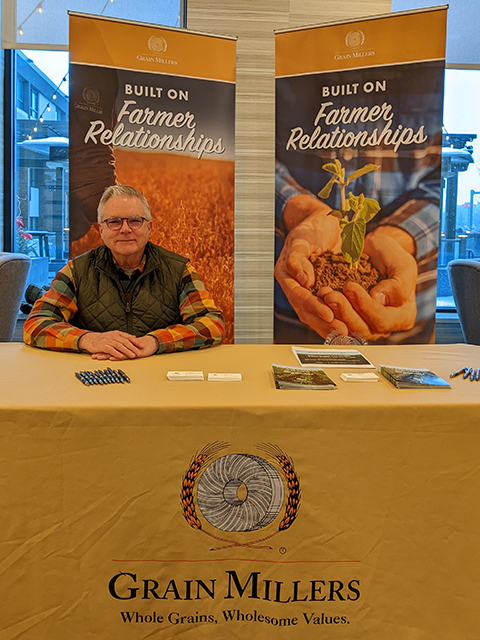
Craig Tomera, Identity Preserved Crop Specialist with Grain Millers, chatting with Shane Frederick, Manager of Strategic Programs at SSGA.
Courtney Cheever, State Water Quality Specialist with the USDA’s Natural Resources Conservation Service.
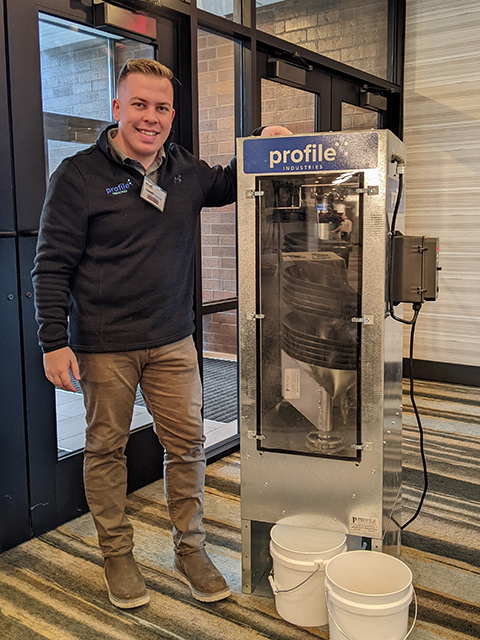
Tommy Saatzer, Business Development Manager at Profile Industries.
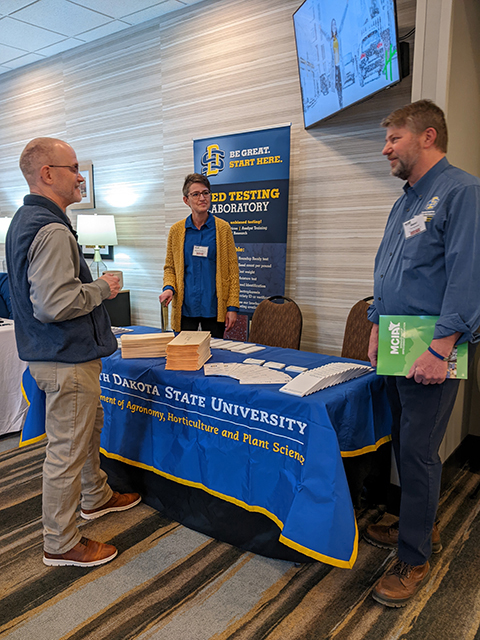
Kathy Mathiason, Seed Laboratory Manager, and Brent Turnipseed, SDSU Professor Emeritus of Agronomy, staffing the SDSU Seed Laboratory booth.
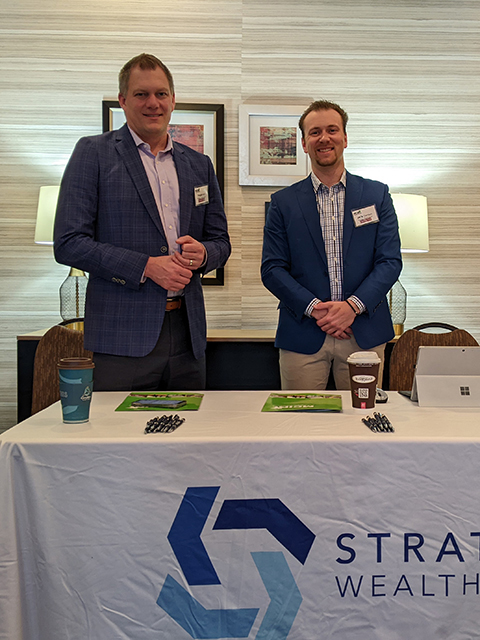
Tyler Hirth (center) and Jack Garrison (right), Wealth Advisors with Strategic Wealth Group, chatting with Brad Barth (left), Chairman of the MCIA Board of Directors.
The 2025 MCIA Annual Meeting, which was held Wednesday, January 29, 2025, included an election to fill two Category A Director seats on the MCIA Board of Directors. Category A directors serve 3-year terms of office. MCIA members elected two persons who are new to the MCIA Board: Brian Jensen (District 1) and Michael Backman (District 2). Members also ratified the nomination of incumbent Nancy Ehlke as the board’s Category B Director (who is nominated by the Director of the Minnesota Agricultural Experiment Station to serve a one-year term of office). In addition, members approved an amendment to MCIA’s bylaws that was proposed by the MCIA Board of Directors.
*
Background information about the newly elected and ratified directors follows.
Brian Jensen
Brian Jensen (District 1). Brian grew up on the family farm near Stephen, Minnesota, and enjoyed helping on the farm and working in the seed conditioning plant at an early age. After graduating high school from Stephen, he attended NDSU and received a degree in agronomy and agriculture economics. He has continued farming and running Jensen Seed Co. with his father and family to this day. The farm grows wheat, barley, soybeans, sugar beets, corn, and dry beans among other crops over the years. The on-farm MCIA-Approved Seed Conditioning facility primarily conditions small grains. Jensen Farms and Jensen Seed Co. have been MCIA members for over 40 years, producing and conditioning certified seed including foundation wheat and barley for MCIA.
Brian has served on the Minnesota Wheat Research and Promotion Council, Augsburg Township, Storm Booster Club, and Church Council. Brian and his wife Betsy have three children and enjoy the diversity of their farm and seed business and look forward to helping the next generation grow. In his spare time Brian enjoys spending time at the lake and outdoor activities with his family.
Michael Backman
Michael Backman (District 2). Michael Backman is a fourth-generation farmer from Herman, Minnesota. Michael farms alongside his parents, Tim and Marilyn, and his brothers, Pat and James. The Backman family raise corn, soybeans, wheat, and sugar beets. In addition to selling corn and soybean seed, they also operate a seed cleaning facility that primarily processes hard red spring wheat.
Off the farm, Michael is an active member of Herman Fire & Rescue, head coach of the local youth downhill ski racing team, Logan Township board member, and a parish council member at St. Charles Catholic Church. Michael and his fiancée, Jonnah, will be married this coming July.
Nancy Ehlke
Nancy Ehlke (Nominee from the University of Minnesota) Nancy Ehlke is a professor and plant breeder in the Department of Agronomy and Plant Genetics at the University of Minnesota. She has been a member of the department faculty since 1986 and is nationally recognized as a plant breeder working on forage legumes, turf grasses, and native plant species. She is also a fellow in both the American Society of Agronomy and the Crop Science Society of America. In addition to her administrative and teaching responsibilities, Nancy leads research and outreach activities in northern Minnesota with the grass and legume seed producers. She received her PhD from Pennsylvania State University. She has been an MCIA board member since 2006.
*
Members approved the following amendment to Article XII—Miscellaneous, 12.8 Financial Accounts, of the MCIA bylaws:
The Board of Directors shall examine the accounts of the Association at their meetings as set forth herein, and shall, in addition, conduct a financial review every year and a financial audit at least once every three years by a disinterested competent accountant, or by a committee of three members of the Association who are not members of the Board of Directors.
Approved bylaws revision, above, highlighted in red.
On January 25, 2029, Minnesota Crop Improvement Association presented its highest honor, the Achievement in Crop Improvement Award, to brothers Mac Ehrhardt and Tom Ehrhardt of Albert Lea Seed.The award, presented annually since 1972, recognizes exemplary service to the seed industry as well as outstanding leadership in agriculture.
The recipients of MCIA’s Honorary Premier Seed Grower Award this year were retired MCIA field inspector Lonnie Perrine and Brent Turnipseed, Professor Emeritus of Agronomy, South Dakota State University. This award recognizes individuals not directly involved in seed production but who have actively supported the seed industry, MCIA, and their local community. MCIA has presented this award annually since 1930.
The awards were presented at the Minnesota Crop Improvement Association’s 122nd Annual Meeting. The event was held at the Holiday Inn and Suites in St. Cloud, Minnesota, January 29, 2025.
Following are brief profiles of each awardee. More detailed coverage will be provided in the spring issue of the Minnesota Seed Grower.
Achievement in Crop Improvement Award
Mac Ehrhardt accepts MCIA’s Achievement in Crop Improvement Award from Kevin Schulz, editor of the Farmer magazine.
Mac Ehrhardt and Tom Ehrhardt are third-generation co-owners of Albert Lea Seed, a family business located in southern Minnesota, founded in 1923. At the start, it provided seed and other farm supplies. As children, the two brothers did age-appropriate work for the business, sweeping the seed conditioning plant and bagging seed potatoes and garden seeds. After graduating from college, both brothers found their way back home and eventually assumed leadership of the family business, working side-by-side for over thirty years.
While the company has always worked with a wide range of certified crop species, their growth and niche has been in nontraited and organic seed. Albert Lea Seed became one of the top suppliers of non-GMO and organic seed in the United States. Their Blue River Organic, Viking Non-GMO, and Albert Lea Seed product lines are well known across the country. Their success story continues today with over 40 employees and 6,000 customers across the Midwest and beyond. The business has adopted a stock-ownership structure that will, over time, transition ownership of the company to an employee group, establishing the next generation of management.
Mac and Tom’s involvement with MCIA runs deep, as heirs to decades of certified seed production and as advocates for new program development; for example, MCIA’s Non-GMO Seed Traceability and 99.9% Non-GMO programs.
The Ehrhardt brothers have worked with countless farmers and seed producers across the state, building relationships as well as a tremendous reputation. Among Albert Lea Seeds’ innovations are online seed sales, field days, and crop production conferences. Tom and Mac have both said that personal relationships with their customers and seeing their customers’ success in the field have been two of the greatest rewards of Albert Lea Seeds’ business.
Mac Ehrhardt accepted the Achievement in Crop Improvement Award, saying, “I’m really honored because I feel like I’m accepting it on behalf of everybody in my company, because it’s a team.”
Premier Seed Grower Awards
Brad Barth, Chairman of the MCIA Board of Directors, receives MCIA’s Premier Seed Grower Award from Fawad Shah, MCIA President/CEO.
Brad Barth, of Thief River Falls, grew up in northern Minnesota, and was introduced to farming through his father’s work in agriculture. However, Brad’s first career, lasting 17 years, was in accounting. Around 1997, he and his wife, Joyce, started Brad Barth Farms, doing custom work and their own crop production. About 10 years later, they built an MCIA-approved, on-farm seed conditioning facility and seed business.
Today, Brad Barth Farms grows certified wheat varieties that they sell and supply to many area growers and MCIA Approved Facilities. Almost all their soybean seed production is for a private company.
Brad has served on the MCIA Board of Directors for six years, five of those years as chairman. Hosting the AOSCA annual meeting in Minesota in 2023 was a highlight of his board tenure.
Brian Jensen, recipient of MCIA’s Premier Seed Grower Award.
Brian and Betsy Jensen, of Stephen, farm from the edge of the Lake Agassiz beach ridge to the heart of the Red River Valley. Brian grew up on his family’s farm near Stephen, Minnesota. Betsy grew up near Bricelyn, Minnesota. Her family had a crop and livestock farm and owned a Case farm equipment dealership.
The two met while studying at NDSU. After they married, Brian returned to the farm and seed business; Betsy worked as a commodity broker. A few years later, she began teaching farm management at Northland College. She has also conducted marketing classes and written a regular column for Prairie Grains magazine.
Brian and Betsy have continued to grow their farm, raising wheat, barley, soybeans, sugar beets, canola, and pinto beans. Their seed business, Jensen Seed Co., conditions certified seed and does custom cleaning. They raise and condition MCIA foundation seed. Brian and Betsy are very active in their local community.
Maynard Peterson, recipient of MCIA’s Premier Seed Grower Award.
Maynard Peterson, of Stephen, grew up in a farming family in northwest Minnesota and northeast North Dakota. He attended East Grand Forks Technical college for diesel mechanics, all the while working on the family farm. After college, he worked for neighboring farmers, and at his own farm operation. His farm grew, field by field. Maynard’s certified seed production started when a nearby farmer, John Jensen, asked him to grow certified seed, as Jensen Seed Co. had an on-farm seed conditioning facility. Seed production became an important part of the farm.
Today the farm grows wheat, soybeans, sugar beets, corn, and canola. Seed production continues for both certified wheat and soybeans for a private company. Maynard says he has always enjoyed growing crops, raising seed, and the great friendships he has made in the seed business.
Honorary Premier Seed Grower Awards
Lonnie Perrine, recipient of MCIA’s Honorary Premier Seed Grower Award.
Lonnie Perrine, of Perham, began working for MCIA as a part-time field inspector in 1999. He inspected his final fields for MCIA in 2021. Over the years, Lonnie has inspected tens of thousands of acres of small grains and soybeans. He also inspected approved seed conditioner and bulk handling facilities for 10 years.
Describing varieties is both a technical ability and art. Through the years, Lonnie’s report writing and documentation became well known for their detail, clarity, and professionalism. Lonnie provided MCIA with one of its most valuable inspection tools ever: “Lonnie’s Soybean Grading” card. It is used by MCIA’s inspectors to determine the timing of field inspections.
Lonnie and his wife, Linda, have lived on their farm in the Perham area for over 47 years. Lonnie was recently recognized by his local church for over 50 years of dedication as a member of the worship team.
Brent Turnipseed, recipient of MCIA’s Honorary Premier Seed Grower Award.
Brent Turnipseed has had a long and illustrious academic career. In his 33 years (so far) at South Dakota State University he has served as an assistant department head, professor, seed laboratory manager, student advisor, research lead, and crops team coach. Today, in what is described as a “working retirement transition,” he serves as Interim Department Head of the Agronomy, Horticulture, and Plant Science Department. Brent’s seed laboratory work and research, along with his teaching and student advising, is well known throughout the Midwest and the entire country.
Brent has worked closely with MCIA in many aspects of seed testing, including conducting all seed tests on MCIA samples for many years and, today, the SDSU Seed Laboratory partners with MCIA on tests that need to be outsourced.
There is no way to truly measure the impact Brent has made on his students, staff, and the seed industry over the years. His contributions may best be described as unmeasurable.
At every annual meeting of the Minnesota Crop Improvement Association, the association’s president reports on MCIA’s activities over the past year and provides an assessment of the state of the organization. Following are highlights from Dr. Fawad Shah’s presentation to MCIA membership on January 24, 2024.
Dr. Fawad S. Shah, MCIA President/CEO, introduced MCIA’s staff members. Next, he reported that fiscal year 2022–23 was another successful year for MCIA. Total revenues were $3,435,306 while total expenses were $3,218,024. MCIA has a general investment and a building reserve account. In 2015, the total investment value was approximately $2.5 million. Strategic Wealth Group has taken a progressive and careful approach to both accounts, which have almost doubled since that time, with a current value of $4,865,936. Organic Services led all departments in revenue generated followed by Field Services, Foundation Seed Services, Certification Services, and the Seed Laboratory. Organic Services’ revenue continues to steadily grow. Revenues for Certification and Field Services continue to be strong but fluctuate in tandem with the number of acres applied for each year. Major expenses for all departments include salary, benefits, and payroll taxes.
The President then reported on the 2023 AOSCA Annual Meeting hosted by MCIA in Bloomington, Minnesota. MCIA raised over $16,000 in sponsorships, developed and prepared registration packets, and provided logistical support. MCIA staff along with the board chairman attended and hosted the hospitality suite. Thom Petersen, the Commissioner of the Minnesota Department of Agriculture, offered welcoming remarks and Tom Slunecka, CEO of the Minnesota Soybean Growers Association, was the guest speaker at the awards banquet. Overall, the meeting was a success and a great opportunity for MCIA to participate in various committees and discussions with AOSCA members.
MCIA was featured in several articles over the past year. In October, Seed World reported on MCIA’s receipt of AOSCA’s Excellence in Innovation Award. In another article Seed World reported on AOSCA’s honoring of Roger Wippler with an Honorary Lifetime Membership. Seed World also interviewed MCIA’s president, which led to the article “Should a State-Level Seed Certification Agency Invest Money Outside their State and Outside of Seed Certification?” In November, MCIA was the topic of a Star Tribune article.
The President conducted a talk about seed corn production at the Corn Conference held at the University of Agriculture, Pakistan. The President also presented an overview of MCIA to Delta Theta Sigma fraternity, led tours of the MCIA seed lab and conditioning facility, and he continues to develop curriculum and teach a Seed Science, Technology & Society course at the University of Minnesota.
Staff changes at the organization included the retirement of Foundation Seed Services Manager Roger Wippler and the subsequent promotion of Carl Anfinson as manager of the department. Claire Chapman Biel in the seed lab was promoted to seed technologist. Kate Sinnott was hired in August to fill the seed technologist position vacated by Sam Banks in March. Sarah Lindblom and Tessa Parks joined Organic Services as organic certification specialist/inspectors in June.
MCIA’s Field Services inspected roughly 200,000 acres in 2023. Nearly 180 facilities are inspected each year under the Approved Facility Program. Field Services staff also perform organic inspections and administer the MnDOT Approved Seed Vendors Program. Field Services continue to perform third-party audit inspections to facilitate specialty grain movement into international markets.
The MCIA Seed Laboratory tested 2,943 samples in the past year. The top five crops being tested are perennial ryegrass, soybeans, wheat, corn, and oats. Training of new staff continues. Clair Chapman Biel attended a four-day germination workshop at Iowa State University. The seed lab completed proficiency testing for SCST, USDA ASL, and ISTA. A customer survey was circulated and feedback was positive; 97 percent of customers were very satisfied with the service they receive.
Foundation Seed Services hosted an open house for the UMN breeding program staff and graduate students. Also, Foundation staff provided an education session to Minnesota Department of Agriculture staff. Foundation seed sales increased by 15 percent compared to year 2022. MCIA prepared six new license agreements for five soybean lines and one winter barley line.
Organic services increased the number of clients served from 564 to 585. The staff within the organic department participated in the IOIA Crop and Processor Training courses. A new NOP rule, Strengthening Organic Enforcement, requires that certificates be issued from the OID, a procedure which MCIA has already implemented. There will be an NOP on-site audit in July of 2024.
Administration and Certification staff worked closely with AOSCA to host their annual meeting event in June. Staff worked together to organize a new venue and program for the MCIA Annual Meeting. MCIA conducted an RFP process and contracted with a new managed IT services provider. There will be an on-site AOSCA certification audit in the spring or summer of 2024.
The President explained how MCIA communicates with members. Its publications include an annual Directory, a quarterly newsletter, the Minnesota Seed Grower, and a monthly bulletin, Samplings, as well as the annual Minnesota Certified Seed Guide. MCIA’s website has a blog, press releases, and article links that provide even more information.
Note: The full, official minutes of the 2024 MCIA Annual Meeting, which include the President’s Report, were published in the spring 2024 issue of the Minnesota Seed Grower.
On January 24, 2024, members of the Minnesota Crop Improvement Association joined the organization’s staff and board members for the Association’s 121st Annual Meeting.
Emerging Leaders in Seed Production panelists: Conner Danielson, Ridgewater College student and FFA member; Betsy Jensen, Northland Community and Technical College; Kelsey Henke, Anderson Seeds of St. Peter; Jake Thompson.
The program began with a lively panel discussion on the topic Emerging Leaders in Seed Production. Four panelists fielded questions from the moderator, MCIA President/CEO Fawad Shah, and from attendees. Josh Thompson, of Middle River, asserted the value of working with integrity and upholding high standards. Kelsey Henke, of Anderson Seeds of St. Peter, spoke to the benefits of gaining wide-ranging work experience, even if it sometimes means stepping outside of one’s comfort zone. Conner Danielson, FFA member and Ridgewater College student, discussed how he has sought opportunities in farming by engaging with neighbors, through formal education, and via ag organizations, like FFA. Betsy Jensen, of Jensen Seed Company, emphasized the importance of tracking your financials and establishing sources of value-added or off-farm income to assure stability.
Anthony Cortilet of the Minnesota Department of Agriculture (MDA) then offered a presentation regarding MDA’s new role in cannabis seed labeling and sales in the state. Minnesota Seed Law requires permitted labeling of cannabis seed. As of July 2023, he noted, there were seventy-five permitted cannabis labelers of cannabis seed in the state. MDA will conduct inspections to check compliance. In this initial period, inspectors will take an educational approach with labelers found to be out of compliance, rather than issue Stop Sale Orders. Also, MDA will be willing to accept smaller seed testing samples to accommodate the new cannabis industry.
Left: Anthony Cortilet, Minnesota Department of Agriculture, Plant Protection Division, Section Manager. Right: Roger Wippler, MCIA Foundation Seed Services Manager, retired.
Next up was Roger Wippler, who recently retired as MCIA’s Foundation Seed Services manager. Roger’s presentation reflected on 30 years of change in Minnesota agriculture, the seed industry, and MCIA. Roger’s career began in the heyday of seed certification, but he also witnessed its precipitous decline as private companies captured an increasing share of the seed market. MCIA closed its seed laboratory in 2007 but reopened it nine years later under more auspicious circumstances. MCIA has steadily diversified its services—adding sod and seed Quality Assurance, forage and mulch certification, native seed certification, organic certification, and more. While MCIA has always had a close relationship with the University of Minnesota, in recent years it has taken a more prominent role in promoting University of Minnesota-developed crop varieties.
What does the future hold? Roger foresees more change. There are efforts such as the Forever Green Initiative to develop new winter-hardy annuals and perennial crops with an eye toward improved soil health. Biotechnology also promises to drive change in the seed industry. Continuing to involve its members in governance, seeking out new opportunities, managing the growth of the Organic Services department, and maintaining cooperative relationships with business, government, and academic partners will all be critical factors in the continued success of the Minnesota Crop Improvement Association.
MCIA President/CEO Fawad Shah and MCIA Board of Directors Chairman Brad Barth.
During the business meeting segment of the Annual Meeting, members heard organizational and fiscal reports from officers of MCIA’s Board of Directors. MCIA President/CEO Fawad Shah also delivered a report on the state of the association. Board Chairman Brad Barth presided over the election of one incumbent, Kelsey Henke, and two new board members, Gabel Hoseth and Anthony Cortilet. Members also ratified Nancy Jo Ehlke to serve another year on the board as the UMN’s nominee. See our earlier post for more information about the board election. (We’ll provide the president’s report and the business meeting minutes separately.)
In accordance with tradition, MCIA made time during the Annual Meeting to recognize those whose contributions and achievements have contributed to the success of the seed industry. MCIA Field Services Manager Kris Folland emceed the ceremony. The recipient of this year’s Achievement in Crop Improvement Award was Roger Wippler. Scott Lee, Larry Riopelle, and Merle Schwenzfeier and Roger Schwenzfeier were the Premier Seed Grower Award honorees. Dr. Eric Watkins and Kris Folland himself received the Honorary Premier Seed Grower Award. Roger Wippler stepped in to present Kris Folland with his award. See our previous post for profiles of these recipients and further information about the awards.
The day had more accolades in store for Roger Wippler. David Kee, Director of Research at the Minnesota Soybean Research and Promotion Council, presented Roger with an award from Minnesota Soybean, recognizing Roger’s “many years of service to Minnesota Soybean Growers.”
Roger Wippler, MCIA Foundation Seed Services Manager, retired, receives an award of recognition from David Kee, Director of Research at the Minnesota Soybean Research and Promotion Council.
This year, MCIA changed the Annual Meeting format to better accommodate attendees, most of whom have significant travel times. We shortened the program to five hours. We started later in the morning and ended earlier in the afternoon. We included lunch but held our awards ceremony separately. The later start and unstructured lunch allowed attendees free time to visit our trade show exhibitors.
Except for virtual gatherings during the recent pandemic, MCIA has for many years been holding our Annual Meeting in Fergus Falls. MCIA’s board chose a different location and venue for this year’s meeting, the Holiday Inn & Suites in St. Cloud. Based on positive attendee evaluations, the board has decided to return to St. Cloud for MCIA’s 2025 Annual Meeting. Please plan to join us then!
On January 24, 2024, Minnesota Crop Improvement Association presented its highest honor, the Achievement in Crop Improvement Award, to Roger Wippler, who recently retired as manager of MCIA’s Foundation Seed Services. The award, which MCIA has presented annually since 1972, recognizes exemplary service to the seed industry as well as outstanding leadership in agriculture.
MCIA also recognized four Premier Seed Grower awardees, Scott Lee of Benson, Larry Riopelle of Argyle, and Merle Schwenzfeier and Roger Schwenzfeier of Hallock. Each year since 1928, MCIA has presented this award to recognize individuals or partners involved in quality seed production, active in MCIA, and who provide excellent service to the seed industry.
The recipients of MCIA’s Honorary Premier Seed Grower Award this year were MCIA Field Services Manager Kris Folland and Dr. Eric Watkins, Vice Provost for Distributed Learning at the University of Minnesota and Professor in the Department of Horticultural Science at the UMN’s College of Food, Agriculture and Natural Resource Sciences. This award recognizes individuals not directly involved in seed production but who have actively supported the seed industry, MCIA, and their local community. MCIA has presented this award annually since 1930.
The awards were presented at the Minnesota Crop Improvement Association’s 121st Annual Meeting. The event was held at the Holiday Inn & Suites in St. Cloud, Minnesota.
Following are brief profiles of each awardee. More detailed coverage will be provided in the spring issue of the Minnesota Seed Grower.
Achievement in Crop Improvement Award
MCIA Board Chairman Brad Barth with Roger Wippler, recipient of the Achievement in Crop Improvement Award.
Roger Wippler, of Roseville, after a 34-year career with the Minnesota Crop Improvement Association, recently retired from his position as Foundation Seed Services manager. Roger grew up on a hobby farm near Randall, Minnesota. His love for agriculture began when he was old enough to help area farmers by picking rocks, stacking hay bales, and milking cows. He went on to study landscape technology and agriculture education in college. After stints as an energy auditor, landscaper, and educator, in 1989 he joined MCIA. Roger has been involved in the Association’s longstanding efforts to diversify its services, leading the development of the Variety Licensing Program. He has also been something of an ambassador for the Association, helping to maintain and strengthen its relationships with partner organizations such as AOSCA, the Minnesota Department of Agriculture, the University of Minnesota, and commodity groups. He has also done public outreach for MCIA by staffing the Certified Seed exhibit at the Minnesota State Fair. Outside of MCIA, he has served as a UMN Extension Master Gardener for 24 years. Roger accepted the Achievement in Crop Improvement Award with gratitude, saying, “I greatly appreciate this honor. It has truly been a privilege to work with members of MCIA and be a part of this great organization.”
Premier Seed Grower Award
Scott and Catie Lee.
Scott Lee, of Benson, raises certified wheat and oats to be conditioned and sold to local farmers. He also grows soybean seed and corn. Lee’s Seed Farm has been an active seed producer and MCIA member since it was established by Scott’s father, Wallace, in 1969. The operation includes a seed cleaning plant. Scott serves on the board of the Minnesota Wheat Research and Promotion Council and has been involved in many local, regional, and national agriculture organizations. Lee’s Seed Farm has been the location and host of the University of Minnesota small grains research plots for many years.
Josh Kostrzewski of Riopelle Seed Co. accepts the Premier Seed Grower Award on behalf of Larry Riopelle from Brad Barth, Chairman, MCIA Board of Directors.
Larry Riopelle, of Argyle, grew up working on the Riopelle Seed Farm, which was started by his father and uncle. He continued helping out on the farm while studying farm management in college. Within nine years of graduating, he and a cousin would be running the business. The farm has produced certified seed for decades. During Larry’s tenure, the farm added bulk seed handling and seed treating. Today, Larry’s son, Josh, operates the business along with his business partner, Adam. They continue to grow all classes of certified wheat seed, including foundation seed for MCIA. Larry has served on many boards in his community and is a member of the Minnesota Wheat and Soybean associations.
Roger Schwenzfeier, accompanied by his wife, Phyllis Schwenzfeier, receives the Premier Seed Grower Award from Brad Barth, Chairman, MCIA Board of Directors.
Brothers Merle Schwenzfeier and Roger Schwenzfeier, of Hallock, grew up near Orleans Minnesota, raising livestock and producing crops. After college, they began farming together, a partnership that endured until Roger’s retirement. The next generation is now involved with Merle in running the farm. The Schwenzfeiers grow wheat, soybeans, and sugar beets, and every year they grow certified wheat seed. They have been active seed producing members of MCIA for over 40 years. Both Merle and Roger have served on local boards, including the school, church, and elevators.
Honorary Premier Seed Grower Award
Kris Folland, accompanied by his wife, Bethany Folland, receives the Honorary Premier Seed Grower Award from Brad Barth, Chairman, MCIA Board of Directors.
Kris Folland, of Halma, began his career with the Minnesota Crop Improvement Association in 2006 as a field supervisor, managing seed certification and seed production for northern Minnesota. Since 2019, he has been the able manager of MCIA’s Field Services department. Kris has worked with all facets of MCIA’s processes and procedures, program reviews and development, and standards. His successful efforts to develop new business relationships have been a key to MCIA’s growth. Kris and his wife, Bethany, farm together and are both involved in the Kittson Country 4-H. Kris also serves, or has served, on many local, regional, and state boards and committees.
Dr. Eric Watkins, Professor and Vice Provost for Distributed Learning at the University of Minnesot, receives the Honorary Premier Seed Grower Award from Brad Barth, Chairman, MCIA Board of Directors.
Dr. Eric Watkins has taught at the University of Minnesota since 2004. In addition to being a professor in the CFANS Department of Horticulture Science, in 2022 he took on the position of Vice Provost for Distributed Learning. Dr. Watkins’ research has been important to the success of northern Minnesota’s turfgrass production. His research focuses on the development of low‐input turfgrass cultivars for use in cold climates. Research activities involve germplasm improvement of several cool‐season turfgrass species including fine fescues and perennial ryegrass. He is also involved with turfgrass cultivar evaluation and other turfgrass science research. Dr. Watkins has taught several university courses related to turfgrass management and plant breeding.
Every year, MCIA is honored to have the support of sponsors and exhibitors for our Annual Meeting. Our sincere thanks to following organizations and businesses whose support contributed to the success of the 2024 MCIA Annual Meeting, held January 24, 2024, at the Holiday Inn & Suites in St. Cloud.
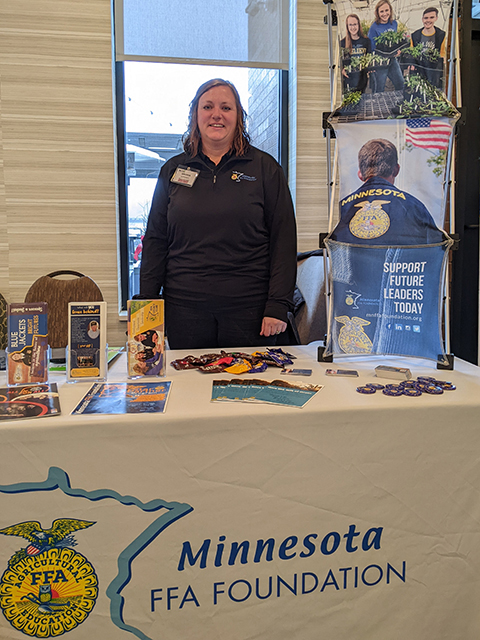
Wealth advisors Tyler Hirth and Jack Garrison of Strategic Wealth Group.Kevin Schulz, editor of The Farmer magazine, chats with Kathy Mathiason and Brent Turnipseed, assistant manager and manager, respectively, of the SDSU Seed Testing Lab.Tommy Saatzer, Business Development Manager, Profile Industries.Craig Tomera, Identity Preserved Crop Specialist, Certified Crop Advisor, and Sustainability Specialist for Grain Millers.Gabe Loraas, Regional Sales Manager—Midwest, with AMVT.Amanda Sommers, Program Coordinator for Minnesota FFA Foundation.