Lab Report

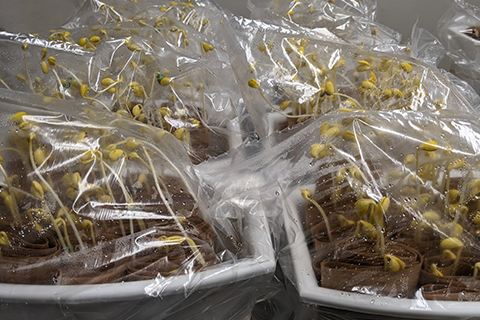
Black soybeans. Photo: MCIA.

By Chase Mowry, Seed Laboratory Manager

Well, we survived another year.

Since the last Seed Lab update, sample quality has continued to be high, with very few disease issues encountered in germination tests. The main cause of lower germination percentages in soybeans was due to mechanical damage, perhaps related to the dry conditions last fall. However, despite those conditions, the average germination percentage this year, among all soybeans tested (certified and service samples), was 90 percent, with 92 percent as the median. In terms of samples received, our busiest months were January through March, as expected. The total number of samples tested this year is comparable to that of the previous few years, upward of 2,800. The top five crop types tested this season were perennial ryegrass, soybeans, wheat, corn, and oats.

Unfortunately for us, seed technologist Sam Banks departed MCIA in March to pursue a job opportunity with another laboratory. Recently, we successfully completed the interview process to fill the vacancy. A new staff member will join the Seed Laboratory in August.

In April, Claire Biel attended a four-day germination workshop held at Iowa State University in Ames, Iowa. The focus of the workshop included test preparations, evaluating germination tests in large-seeded crop types and small grains, tetrazolium testing, and common issues encountered during viability testing. During a germ evaluation, seed analysts distinguish differences between what is considered a normal seedling (those seedlings possessing essential structures that are indicative of their ability to produce plants under favorable conditions), an abnormal seedling, dead seed, and hard or dormant seeds.

In the upcoming summer months, as samples begin to slow, our focus in the laboratory will shift to other tasks—many of which pertain to accreditation and ensuring quality results for the next testing season. We will stay busy with training, updating SOPs, calibrating equipment, purchasing new supplies, conducting an internal audit, discarding samples from cold storage, and evaluating grow-outs, to name a few.

Lastly, be on the lookout for the 2022–23 Seed Laboratory Customer Satisfaction Survey email. This will be a short, 10-question survey to provide feedback on how we did this past year. If you could take a moment to respond, we would very much appreciate it!


Seed Lab Survey: Are You Satisfied?

question mark
Illustration by chenspec from Pixabay.

In June, Seed Laboratory Manager Chase Mowry will be sending out a customer satisfaction survey, via MailChimp, to MCIA Seed Lab customers.

Please watch for it and take a few minutes to respond to the questions.

If you do not receive a survey request and would like to participate, please contact Chase at chase.mowry@mncia.org.

Your participation is greatly appreciated!


Lab Report

By Chase Mowry, Seed Laboratory Services Manager

Noxious Weed Seed Examinations

Noxious weed seed examinations are one type of test that analysts in seed labs routinely perform. The objective of this test is to identify noxious weed seeds present in a sample and determine the estimated rate of occurrence of said species in the seed lot. This information is to be used for labeling purposes for selling seed as required by seed law. Depending on the needs of a seller, different types of noxious weed seed examinations can be conducted.

Each state has defined noxious weed seed species and an allowable rate of occurrence in their seed law. As well, the Federal Seed Act includes a list of noxious weed seed species. If seed is to be sold within the state, only that state’s noxious species are in effect. When shipping seed across state lines, the federal and receiving state’s noxious weed seed species come into effect. It is the responsibility of seed dealers to know the requirements of state laws and the changes in those laws.

If selling seed out of state, one should request a noxious exam that covers the receiving state’s noxious weed seeds, or request an All States noxious exam. If purchasing seed from another state, one should ask to be provided with documentation that clearly indicates the exam type conducted, prior to making a purchase.

The Seed Regulatory and Testing Division (SRTD), USDA AMS, issues the Noxious-Weed Seed Requirements Recognized in the Administration of the Federal Seed Act publication, which lists the noxious weed seeds in each state and summarizes the states’ requirements. The SRTD updates the publication when informed of changes to state seed laws (the most recent revision was February 2022). This publication, as well as the Federal Seed Act, is available at https://www.ams.usda.gov/rules-regulations/fsa. One footnote of particular interest, listed under prohibited weed seed species for Minnesota, states that genetic testing must be conducted of any Amaranthus contaminant to determine if the species is Palmer amaranth (Amaranthus palmeri).

When exporting seed out of the country, specific noxious examinations based on the destination of the seed lot are also required. The MCIA Seed Laboratory routinely performs Canadian Noxious Weed Seed Exams and EC Other Plant Species Exams on submitted samples as well. As with domestic testing, the results obtained provide necessary seed contaminant information required for labeling exported seed.


Job Opportunity for Seed Lab Technologist

Minnesota Crop Improvement Association is seeking qualified candidates for the position of Seed Technologist.

This full-time position offers a competitive salary and full benefits. MCIA’s Seed Laboratory operates out of MCIA’s main office on the campus of the University of Minnesota Twin Cities.

For more information, read the full position announcement on our job openings page.

Read more about the MCIA Seed Laboratory here.


Seed Testing Tips

Image by Mattias Böckel from Pixabay.

FYI: Days Required for Germ Tests

  • Barley: 7 days
  • Corn: 7 days
  • Oats: 10 days
  • Rye: 7 days
  • Ryegrass: 14 days
  • Soybeans: 7 days
  • Wheat: 7 days

Note: The MCIA Seed Laboratory has stopped prechilling samples for the season, unless required in the AOSA Rules for Testing Seeds. If you would still prefer to have a prechill done, please indicate so in the remarks section of the Sampling Report.

Reminder: You can rely on the Seed Laboratory to perform germination updates on carryover seed and/or seed lots whose test dates have expired. This includes service samples, not just certified seed.


Claire Biel Joins Seed Laboratory Staff

Claire Biel, Lab Technician

Minnesota Crop Improvement Association welcomes Claire Biel to our staff! Claire has assumed the position of Lab Technician in the Seed Laboratory.

She began her career at MCIA in October. Claire is a recent graduate of the University of Minnesota, where she earned a B.S. in plant science with an emphasis in agroecology. As a student research assistant, she worked on a USDA-NIFA Coordinated Agricultural Project titled Pennycress Research Enabling Farm and Energy Resilience. Her work focused on pennycress genetics and breeding. She performed DNA extraction and seed germination, screening for performance in different conditions, took phenotypic field data, managed a greenhouse, and was also involved in harvest.

To learn more about MCIA’s Seed Laboratory, click here.


Lab Report

By Chase Mowry, Seed Laboratory Services Manager

Image by Andreas Göllner from Pixabay.

We are happy to announce the recent hiring of Claire Biel to fill a vacant seed lab technician position. Claire’s main responsibilities in the laboratory this year will focus on checking in samples, dividing out working samples for purity testing, and planting samples for germination tests. We will also continue training on some of the additional testing services the laboratory offers as well as the requirements of seed certification. Welcome Claire!

Samples submitted to the Seed Laboratory for testing so far this season are slightly behind in comparison to this point in time last year. However, of those received, the overall seed health of samples has continued to look pretty good, and viability results on average are high. We have seen a small amount of Fusarium (scab) infection in germination tests for wheat and rye samples thus far, and Sclerotinia has been present in a handful of soybean samples. Test results for barley loose smut have also shown low infection.

As a reminder, there may be delays in your test results for samples submitted around the holidays as we will plant around the holiday schedule. To prevent any further delays, please be sure to provide all necessary paperwork along with your samples.

If there are any seed testing topics that you would like addressed in future Lab Report columns, please send your ideas to MCIA Seed Laboratory Manager Chase Mowry at chase.mowry@mncia.org.


Lab Report

Wheat seeds. Photo: David Hansen. © Regents of the University of Minnesota. All rights reserved.

By Chase Mowry, Seed Laboratory Manager

This past June, I attended the AOSA/SCST Annual Meeting, held in Skokie, Illinois. This annual joint meeting of the Association of Official Seed Analysts and the Society of Commercial Seed Technologists provides a great opportunity to connect with colleagues within the seed testing community and to discuss emerging technologies in the industry and issues analysts are encountering in their laboratories.

Throughout the four-day event, committees met to discuss various aspects of seed testing, such as research, cultivar purity, germination and dormancy, statistics, and vigor testing. In addition, board and business meetings for the individual organizations were held.

Attending the AOSA/SCST Annual Meeting also provides analysts (SCST) or laboratories (AOSA) the opportunity to vote on rule proposals, submitted by members, to modify the AOSA Rules for Testing Seeds. Analysts follow these rules when conducting domestic testing. The proposals address such issues as adding germination or purity testing requirements for new species, modifying existing testing methods, classifying contaminants, reporting test results, or simply clarifying current rules.

This year, there were nineteen rule proposals: fourteen passed, four failed, and one was withdrawn. Of those that passed, several included adding germination testing methods for new species, species classifications, the addition or modification of common names of a few species, and the addition of Apiaceae seedling illustrations to aid in germination evaluation.

For detailed information on the AOSA/SCST Annual Meeting proceedings, including individual committee reports and rule proposals, visit the AOSA/SCST website: analyzeseeds.com.


Seed Laboratory Reminders

Image by markusspiske from Pixabay.

As we begin a new testing season, here are some important reminders to Seed Laboratory clients:

  • Your sample must be representative of your seed lot. The test results we obtain are a direct reflection of the sample that you provide.
  • Storing your sample prior to submission: Keep samples in a closed container in a clean, dry location, away from excessive heat.
  • Shipping samples: Package your sample properly to minimize damage and to prevent spillage during transit.
  • Include a completed Sampling Report and other relevant documentation for each sample you submit. Missing information may cause delays in MCIA’s ability to perform testing and provide final certification.

If you have any questions, please contact Seed Laboratory Manager, Chase Mowry, at chase.mowry@mncia.org.

Selling Seed Out-of-State?

Are you selling your seed into another state? If so, an All State Noxious Exam is needed. You can request the All State Noxious test on the Sampling Report when you submit your sample.

If you have further questions, please contact the MCIA Seed Laboratory or your field supervisor.


Seed Lab Reminders

Photo © Minnesota Crop Improvement Association.

Friendly reminders to MCIA Seed Laboratory clients:

Be sure to include a Sampling Report with every sample submitted for testing. Whether it be for a retest or a germ update, a Sampling Report is necessary for recording date received, assigning a lab number, tests requested, as well as any other pertinent information regarding your seed lot.

New crop small grains and turf grasses may require extra germination time due to pre-chill requirements. Be sure to include the year of production on the Sampling Report.

Loose smut tests can be conducted on each barley field at the time of harvest, eliminating the need for a smut test on every lot. Loose smut results must be included on the bulk sales certificate or seed tag.